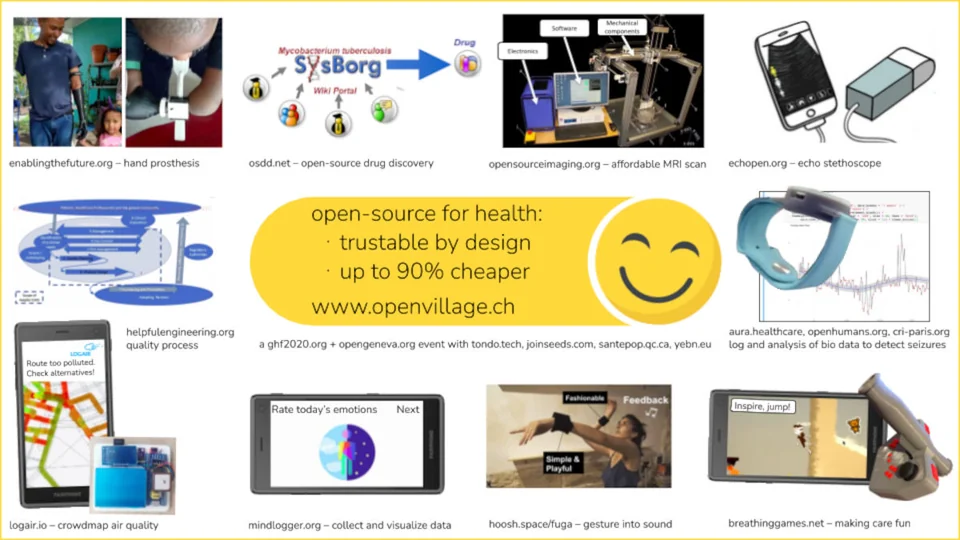
← Edition 2020 · Health technology as commons: trustable, affordable, adaptable
Fablab: reproducing open hardware
- Date
- 16–18 November 2020
- Venue
- online
Discover how to design and reproduce the hardware. Depending on interest, participants will be able to assemble the devices during a session in early 2021.
Technical workshops, 90 min.
Programme
- Monday 16 November, 13:30
F4. Designing a 3D-printed hand prosthesis
Presentation by the founder of E-nable, the E-nable Nepal team, and the design of hand, finger and palm prostheses by Gre-nable.
- Monday 16 November, 17:15
F3. Exploring physiology with a connected device
Equip participants with a connected patch and a motion sensor to explore what these signals can teach us about our body and the risks for our privacy. By Aura, OpenHumans and Makerlab CRI.
- Tuesday 17 November, 14:45
F1. Combining spirometry and air quality measurement
Join us to create, assemble and test hardware related to respiratory and environmental health. Presentation of the hardware, open collaboration. No prerequisites or essential skills. By Breathing Games and LogAir.
- Tuesday 17 November, 17:15
F5. MRI scanner and other open hardware projects
Presentation of the Open Source Imaging project (study on economic value), followed by participants' projects.
Open Source Imaging · On the Economic Value of Open Source Hardware
- Wednesday 18 November, 11:00
F2. Designing phantoms that simulate veins
To let doctors practise ultrasound-guided procedures. By EchOpen.
Programme of the Open Village 2020 (festival document).
Videos and media
Videos load only when clicked, from Vimeo (without tracking) or YouTube (without cookies).
-
Conceiving a 3D-printed prosthesis – Jon Schull, eNable
-
Conceiving a 3D-printed prosthesis – Shikshya Gautam, eNable Nepal
-
Conceiving a 3D-printed prosthesis – Team GreNable France
-
MRI scanners affordable worldwide – Lukas Winter
Photos